The long-term economic benefits of artificial intelligence represent one of the most transformative forces shaping global economies in the 21st century. As businesses, governments, and institutions worldwide accelerate their AI adoption, understanding the profound economic impacts becomes essential for stakeholders across all sectors. This comprehensive analysis explores how artificial intelligence drives sustainable economic growth, transforms labor markets, enhances productivity, and creates unprecedented opportunities for wealth generation over extended time horizons.
Understanding the Economic Impact of AI Technology
Artificial intelligence has evolved from a theoretical concept to a practical economic driver that fundamentally reshapes how value is created, distributed, and measured across global markets. The economic benefits of AI extend far beyond immediate cost savings, encompassing structural transformations that compound over decades.
Economic research indicates that AI implementation generates multiplicative effects throughout entire economic systems. When organizations deploy AI solutions, they don’t simply automate existing processes but unlock entirely new business models, revenue streams, and market opportunities that were previously impossible or economically unviable.
The macroeconomic implications of artificial intelligence adoption differ substantially from previous technological revolutions. Unlike industrial automation that primarily affected manufacturing sectors, AI applications permeate virtually every industry vertical, from healthcare and finance to agriculture and creative services. This universal applicability means the long-term economic benefits of artificial intelligence accumulate across broader segments of the economy simultaneously.
Productivity Gains Through AI Implementation
Productivity enhancement represents the most quantifiable and immediate of the long-term economic benefits of artificial intelligence. Organizations implementing AI systems consistently report productivity improvements ranging from 20% to 40% in affected workflows, with these gains compounding as AI capabilities mature and integration deepens.
AI-driven productivity gains manifest through multiple mechanisms. Machine learning algorithms optimize resource allocation with precision impossible for human managers, reducing waste and maximizing output from existing inputs. Natural language processing systems handle routine communications and documentation tasks, freeing knowledge workers to focus on higher-value strategic activities. Computer vision applications inspect products and processes with superhuman accuracy and consistency, dramatically reducing defect rates and quality control costs.
The productivity benefits of AI implementation extend beyond direct task automation. AI systems generate insights from data patterns that humans cannot perceive, enabling organizations to make better decisions faster. Predictive maintenance powered by AI prevents equipment failures before they occur, minimizing costly downtime. Dynamic pricing algorithms adjust to market conditions in real-time, optimizing revenue capture. Supply chain AI anticipates disruptions and reconfigures logistics networks proactively, maintaining smooth operations despite volatility.
Importantly, productivity gains from artificial intelligence compound over time rather than plateauing. As AI systems accumulate more data, their performance improves continuously through machine learning. As organizations develop expertise in AI deployment, they identify additional opportunities for optimization. As complementary technologies mature, they create synergies that multiply AI effectiveness. This compounding characteristic distinguishes AI from previous productivity tools and explains why the long-term economic benefits of artificial intelligence substantially exceed short-term impacts.
Labor Market Transformation and Workforce Evolution
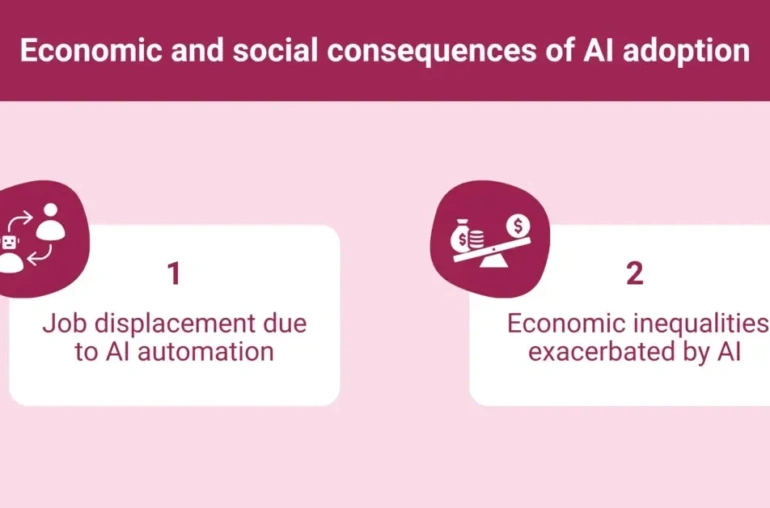
The relationship between artificial intelligence and employment constitutes one of the most debated aspects of AI’s economic impact. While concerns about job displacement merit serious consideration, the long-term economic benefits of artificial intelligence include substantial job creation, wage growth for skilled workers, and evolution toward more fulfilling work.
Historical analysis of technological disruption reveals consistent patterns: new technologies eliminate specific tasks rather than entire occupations, create demand for new skills and roles, and ultimately expand total employment as productivity gains generate economic growth. AI follows these established patterns while introducing unique characteristics that shape workforce evolution.
AI automation primarily affects routine, repetitive tasks across both manual and cognitive domains. However, most occupations comprise diverse task portfolios, many of which remain beyond AI capabilities for the foreseeable future. Tasks requiring creativity, complex problem-solving, emotional intelligence, ethical judgment, and physical dexterity in unstructured environments continue to demand human workers. AI augmentation enhances human performance in these areas rather than replacing humans entirely.
The labor market impact of artificial intelligence includes significant job creation across multiple categories. AI development, deployment, and maintenance require software engineers, data scientists, machine learning specialists, and AI ethics professionals. Organizations adopting AI need change management consultants, training specialists, and business process experts to facilitate transitions. New AI-enabled business models create demand for roles that didn’t previously exist, from prompt engineers to AI content curators.
Wage dynamics in AI-transformed economies exhibit bifurcation. Workers with skills complementary to AI capabilities command premium compensation as their productivity multiplies. Technical professionals with AI expertise enjoy particularly strong wage growth as demand substantially exceeds supply. Conversely, workers performing easily automated tasks face wage pressure unless they develop new capabilities. This skills premium incentivizes education and training investments that boost overall human capital, contributing to long-term economic benefits.
The quality of work improves as artificial intelligence handles tedious, dangerous, or physically demanding tasks. Workers freed from repetitive activities engage in more creative, strategic, and interpersonal work that provides greater job satisfaction and psychological wellbeing. This enhancement of work quality represents an often-overlooked economic benefit with substantial implications for productivity, innovation, and social welfare.
Innovation Acceleration and Research Advancement
Among the most profound long-term economic benefits of artificial intelligence is its capacity to accelerate innovation across scientific research, product development, and process improvement. AI serves as a meta-innovation that increases the rate at which humans discover new knowledge and create novel solutions.
In scientific research, AI dramatically compresses discovery timelines. Machine learning models analyze vast datasets to identify patterns and relationships that would take human researchers years or decades to uncover. AI-powered simulations model complex phenomena from protein folding to climate dynamics, enabling researchers to test hypotheses computationally before expensive physical experiments. Natural language processing systems synthesize insights from millions of research papers, connecting disparate findings into integrated understanding.
Pharmaceutical development illustrates AI’s innovation acceleration benefits. Traditional drug discovery requires 10-15 years and billions of dollars to bring new medications to market. AI systems now identify promising drug candidates in months, predict molecular interactions, optimize chemical structures, and even design entirely novel compounds. This acceleration doesn’t just reduce costs but enables treatments for diseases where traditional approaches were economically infeasible. The resulting health improvements generate enormous economic value through extended productive lifespans and reduced healthcare expenditures.
Materials science experiences similar transformation through AI. Machine learning algorithms predict material properties from atomic structures, guiding development of advanced materials for batteries, semiconductors, construction, and manufacturing. AI optimization identifies ideal material compositions for specific applications, replacing slow trial-and-error experimentation with directed discovery.
Product development cycles shorten substantially with AI integration. Generative design algorithms explore thousands of product variations to optimize for multiple objectives simultaneously, identifying solutions superior to human-designed alternatives. AI-powered testing and simulation reduce the need for physical prototypes. Market analysis AI predicts consumer responses to product features before launch, improving success rates and reducing costly failures.
Process innovation benefits from AI’s pattern recognition capabilities. AI systems analyzing operational data identify bottlenecks, inefficiencies, and improvement opportunities that human observers miss. Continuous learning algorithms adapt processes dynamically to changing conditions, maintaining optimal performance without manual intervention. This perpetual optimization represents a fundamental shift from periodic improvement initiatives to constant evolution.
The innovation acceleration enabled by artificial intelligence creates positive feedback loops in economic development. Faster innovation increases productivity, generating resources for further AI investment. Improved AI capabilities enable still faster innovation in a virtuous cycle that compounds the long-term economic benefits of artificial intelligence over time.
Global GDP Growth and Economic Expansion
Macroeconomic modeling consistently projects substantial GDP growth attributable to artificial intelligence adoption. Authoritative estimates suggest AI could contribute $15-20 trillion to global GDP by 2030, with even larger impacts extending through mid-century as AI capabilities mature and adoption deepens.
These GDP projections reflect multiple mechanisms through which AI drives economic expansion. Productivity gains directly increase output from existing capital and labor inputs. New AI-enabled products and services create markets that generate entirely new economic activity. Improved decision-making optimizes resource allocation across economies, reducing waste and increasing efficiency. Enhanced innovation capabilities accelerate technological progress that underpins long-term growth.
Regional economic impacts vary based on AI adoption rates and complementary factors. Economies with advanced digital infrastructure, strong educational systems, supportive regulatory frameworks, and substantial research investments capture disproportionate benefits from AI development. Early adopters establish competitive advantages in AI-intensive industries, attracting investment and talent that reinforces their leadership positions.
Developing economies face both opportunities and challenges from AI-driven economic transformation. On one hand, AI enables leapfrogging of intermediate development stages by directly adopting cutting-edge technologies without investing in outdated infrastructure. Mobile AI applications bring advanced capabilities to populations lacking traditional computing access. AI-powered education and healthcare narrow development gaps. On the other hand, developing economies risk falling further behind if they lack the technical capacity, human capital, and institutional frameworks to effectively deploy AI.
The distribution of AI’s economic benefits within economies depends heavily on policy choices regarding education, competition, labor markets, and taxation. Without thoughtful interventions, AI adoption could exacerbate inequality as capital owners and high-skilled workers capture most gains while displaced workers struggle to transition. However, policies that ensure broad access to AI training, maintain competitive markets, support worker transitions, and distribute gains equitably can make AI-driven growth more inclusive.
Economic growth from artificial intelligence differs from historical growth patterns in sustainability characteristics. Unlike extractive industries that deplete natural resources, AI applications generally reduce material and energy intensity per unit of economic output. Smart grid AI optimizes energy distribution and integrates renewable sources more effectively. Precision agriculture AI minimizes fertilizer and water usage while maximizing yields. Manufacturing AI reduces waste and improves recycling efficiency. These characteristics align AI-driven economic growth with environmental sustainability objectives in ways previous growth engines did not.
Industry-Specific Economic Transformations
The long-term economic benefits of artificial intelligence manifest differently across industries based on sector-specific characteristics, competitive dynamics, and technological maturity. Examining key industry transformations illustrates the diverse pathways through which AI creates economic value.
Healthcare experiences particularly dramatic economic transformation through AI adoption. Diagnostic AI achieves accuracy rates exceeding human physicians for specific conditions like diabetic retinopathy and certain cancers, enabling earlier intervention and better outcomes. Personalized treatment AI analyzes genetic profiles, medical histories, and real-time patient data to recommend optimal therapies for individual patients, improving efficacy and reducing adverse events. Administrative AI streamlines billing, scheduling, and records management, reducing healthcare overhead costs that consume substantial portions of healthcare spending. Drug discovery AI accelerates development while reducing costs, bringing new treatments to patients faster and making previously uneconomical medications viable.
The cumulative economic impact of healthcare AI extends beyond direct cost savings to include massive value from improved health outcomes. Longer, healthier lives mean extended productive work periods, reduced disability costs, and improved quality of life. Early disease detection prevents expensive late-stage treatments. Precision medicine reduces trial-and-error prescribing that wastes resources and causes complications. These effects compound to generate trillions in economic value over decades.
Financial services leverage AI for risk assessment, fraud detection, algorithmic trading, and personalized financial advice. Credit scoring AI analyzes alternative data sources to extend credit to previously underserved populations, expanding financial inclusion and economic opportunity. Fraud detection systems prevent billions in losses annually while reducing false positives that inconvenience legitimate customers. Trading algorithms provide liquidity and improve price discovery in financial markets. Robo-advisors democratize sophisticated investment strategies previously available only to wealthy individuals, helping middle-class households build wealth more effectively.
Manufacturing benefits from AI through predictive maintenance, quality control, supply chain optimization, and production planning. Predictive maintenance reduces unplanned downtime by 30-50%, substantially improving manufacturing efficiency. Computer vision inspection systems detect defects with superhuman precision, improving quality and reducing waste. Supply chain AI anticipates disruptions, optimizes inventory levels, and coordinates complex global logistics networks, reducing costs while improving responsiveness. Production planning AI balances multiple objectives to maximize output, minimize costs, and meet delivery commitments.
Retail transformation through AI encompasses personalized recommendations, dynamic pricing, inventory optimization, and customer service automation. Recommendation systems drive 35% or more of sales at leading e-commerce platforms by matching products to customer preferences. Dynamic pricing optimizes revenue by adjusting prices based on demand, competition, and inventory positions. Inventory AI reduces stockouts and overstock simultaneously by predicting demand patterns and optimizing distribution. Customer service chatbots handle routine inquiries 24/7 at marginal cost near zero, freeing human agents for complex issues requiring empathy and judgment.
Transportation experiences fundamental restructuring through autonomous vehicles, traffic optimization, and logistics planning. While fully autonomous vehicles remain under development, partial autonomy features already improve safety and efficiency. Traffic management AI reduces congestion, decreasing commute times and fuel consumption while lowering emissions. Logistics AI optimizes routing, loading, and scheduling for delivery fleets, reducing costs that ultimately benefit consumers through lower prices.
Agriculture productivity improves dramatically through precision farming enabled by AI. Computer vision systems identify crop diseases and pest infestations early, enabling targeted interventions that minimize pesticide use. Soil and weather analysis AI optimizes planting, irrigation, and harvesting decisions for maximum yield and quality. Autonomous farming equipment operates continuously with precision impossible for human operators, increasing productivity while reducing labor requirements. These advances help agriculture feed growing global populations while reducing environmental impacts.
Energy sector transformation through AI encompasses exploration, production, distribution, and consumption optimization. Exploration AI analyzes seismic data to identify oil and gas deposits more accurately with fewer dry wells. Production optimization AI manages complex extraction operations for maximum efficiency. Grid management AI balances supply and demand in real-time, integrating intermittent renewable sources while maintaining stability. Consumption optimization AI in smart buildings and homes reduces energy waste without sacrificing comfort.
Cost Reduction and Operational Efficiency
Beyond productivity enhancement, the long-term economic benefits of artificial intelligence include substantial cost reductions across operational domains. These savings compound over time as AI systems improve and organizations deepen their deployment expertise.
Labor cost optimization represents the most visible cost reduction from AI adoption. While complete job elimination occurs less frequently than headlines suggest, AI handles increasing portions of work previously requiring human effort. Customer service AI resolves 60-80% of routine inquiries without human involvement, dramatically reducing support costs for organizations serving millions of customers. Document processing AI extracts data from invoices, contracts, and forms at speeds and accuracy levels impossible for human data entry workers. Back-office AI handles routine accounting, HR administration, and compliance tasks, allowing organizations to maintain smaller administrative staffs.
Energy costs decline as AI optimizes consumption across facilities and operations. Building management AI adjusts heating, cooling, and lighting based on occupancy patterns and weather forecasts, reducing energy usage by 15-25% without compromising comfort. Industrial AI optimizes production processes to minimize energy intensity. Data center AI manages server workloads and cooling systems for maximum efficiency, crucial for organizations where energy represents major operating costs.
Material costs decrease through waste reduction enabled by AI precision. Manufacturing AI optimizes cutting patterns to minimize scrap. Supply chain AI reduces spoilage by better matching supply with demand. Quality control AI catches defects early before value-adding processes amplify losses. Packaging optimization AI designs configurations that protect products while minimizing material usage.
Maintenance costs fall dramatically as predictive AI prevents expensive failures. Rather than scheduled maintenance at fixed intervals regardless of actual condition, predictive systems monitor equipment continuously and recommend interventions only when needed. This approach simultaneously reduces maintenance costs and extends asset lifespans by avoiding both premature replacement and catastrophic failures from neglected maintenance.
Error costs decline as AI systems execute processes with consistency impossible for human workers subject to fatigue, distraction, and cognitive limitations. Billing errors, shipment mistakes, compliance violations, and similar operational failures each carry substantial costs both directly and through customer dissatisfaction. AI reduction of error rates generates savings that compound as operations scale.
Overhead reduction emerges as AI automates coordination and communication functions. Meeting scheduling AI eliminates the back-and-forth of finding mutually convenient times. Project management AI tracks progress, identifies risks, and allocates resources automatically. Reporting AI generates status updates and performance dashboards without manual compilation. While individually modest, these micro-efficiency gains across thousands of daily interactions accumulate to substantial organizational savings.
Risk mitigation costs decrease as AI enhances threat detection and response. Cybersecurity AI identifies intrusions and vulnerabilities faster than human security teams. Fraud detection AI flags suspicious transactions in real-time. Compliance monitoring AI ensures regulatory adherence across complex organizations. The costs avoided through better risk management represent significant economic benefits, especially for organizations in heavily regulated industries.
Investment and Capital Formation
The long-term economic benefits of artificial intelligence include substantial impacts on investment patterns and capital formation that reshape economic structures and growth trajectories. AI influences both where capital flows and how effectively deployed capital generates returns.
AI attracts massive capital investment as businesses, governments, and investors recognize transformative potential. Global AI investment exceeded $200 billion in 2023 and continues accelerating, funding research, infrastructure, startups, and enterprise deployment. This capital formation creates jobs for AI developers, purchases computing hardware from semiconductor companies, and flows through supply chains generating economic activity. The investment boom in AI resembles historical infrastructure investments in railroads, electricity grids, and telecommunications networks that reshaped economies over subsequent decades.
Venture capital allocation shifts toward AI-enabled startups across virtually all sectors. Investors recognize that AI capabilities create competitive advantages difficult for incumbents lacking technical expertise to replicate. This capital flow funds innovation, enables new market entrants, and creates competitive pressure that accelerates AI adoption across industries. The resulting creative destruction improves overall economic efficiency as superior AI-powered business models displace less productive alternatives.
Corporate capital expenditure reallocates toward AI and complementary digital infrastructure. Organizations invest in cloud computing platforms, data infrastructure, AI software, and technical talent acquisition. While substantial, these investments generate returns through productivity improvements, cost reductions, and revenue growth that justify the expenditures. The transition from labor-intensive to capital-intensive operations enabled by AI changes corporate financial structures with implications for everything from tax policy to labor relations.
Return on invested capital improves as AI optimizes capital allocation decisions. Investment analysis AI processes more information, identifies patterns humans miss, and reduces emotional biases that lead to poor investment choices. Portfolio optimization AI constructs diversified portfolios that achieve better risk-adjusted returns than human-managed alternatives. Credit allocation AI directs capital toward high-potential borrowers while avoiding high-risk lending that leads to defaults. These improvements in capital allocation efficiency compound over time to substantially increase economic productivity.
Infrastructure investment benefits from AI-driven planning and execution. Civil engineering AI designs more efficient infrastructure projects. Construction AI optimizes schedules and resource allocation. Maintenance AI extends infrastructure lifespans through predictive interventions. Public investment in AI research and digital infrastructure creates positive externalities that benefit entire economies, similar to historical public investments in basic research, education, and transportation networks.
Small business access to sophisticated capabilities improves through AI democratization. Cloud-based AI services provide capabilities previously available only to large enterprises with extensive resources. Marketing AI helps small businesses identify and reach target customers cost-effectively. Financial management AI provides sophisticated analytics without expensive consultants. Operations AI optimizes inventory and scheduling for better resource utilization. This leveling of competitive capabilities enables smaller enterprises to compete more effectively, increasing overall economic dynamism.
Market Efficiency and Resource Allocation
The long-term economic benefits of artificial intelligence include improved market efficiency and resource allocation that increase total economic welfare beyond what direct productivity gains alone would generate. AI enhances price discovery, matches supply with demand, and allocates resources toward their highest-value uses more effectively than previous mechanisms.
Price discovery improves dramatically through AI analysis of market conditions. Trading algorithms process news, economic data, and market signals in milliseconds, incorporating information into prices faster than human traders could. This rapid price adjustment means market prices reflect available information more accurately, helping capital flow toward productive uses. While algorithmic trading raises concerns about volatility and flash crashes, overall evidence suggests AI enhances market efficiency and liquidity.
Matching markets function more effectively with AI intermediation. Labor market platforms use AI to match job seekers with employers, reducing search frictions and improving employment quality. Ride-sharing apps match drivers with passengers efficiently, maximizing vehicle utilization and minimizing wait times. Dating apps employ AI to suggest compatible partners, improving match quality. These enhanced matching mechanisms reduce waste from poor matches and create surplus value for market participants.
Auction mechanisms become more sophisticated with AI, benefiting both buyers and sellers. Advertising auction AI helps platforms maximize revenue while delivering relevant ads to users. Procurement AI helps buyers identify suppliers offering optimal combinations of price, quality, and reliability. Dynamic auction AI adjusts mechanisms based on participant behavior to maximize efficiency. The resulting improvements in auction design generate billions in additional economic value annually.
Resource allocation across time improves through AI forecasting and optimization. Electricity grid AI balances generation and consumption in real-time while planning for future capacity needs. Agricultural AI helps farmers decide crop selection and planting timing to maximize returns given price expectations and weather forecasts. Inventory AI determines optimal stock levels balancing carrying costs against stockout risks. These intertemporal optimization capabilities reduce waste from both excess and insufficient resources.
Information asymmetry reduction represents a crucial market efficiency improvement from AI. Used car buyer AI analyzes vehicle histories to assess quality, reducing the information advantage sellers traditionally enjoyed. Medical diagnosis AI provides second opinions that help patients evaluate physician recommendations. Contract analysis AI helps small businesses understand complex legal agreements. By reducing information gaps, AI makes markets more competitive and efficient while protecting less sophisticated participants from exploitation.
Transaction cost reduction through AI enables previously uneconomical exchanges. Micropayment systems powered by AI make tiny transactions viable by reducing processing costs. Automated contract negotiation AI reduces legal costs for routine agreements. Supply chain AI enables smaller-scale, more frequent deliveries economical by optimizing routing and consolidation. Each reduction in transaction costs expands the range of mutually beneficial exchanges, growing overall economic activity.
Education and Human Capital Development
The long-term economic benefits of artificial intelligence extend to education and human capital development, where AI enhances learning outcomes, personalizes instruction, and makes quality education more accessible globally. These improvements in human capital formation compound over decades as better-educated populations drive innovation and productivity.
Personalized learning powered by AI adapts instruction to individual student needs, learning styles, and pace. Adaptive learning systems assess student understanding continuously and adjust content difficulty, presentation style, and practice problems accordingly. Students who grasp concepts quickly progress faster, while those needing additional support receive targeted interventions. This personalization improves outcomes for both high-performing students who might be bored by one-size-fits-all instruction and struggling students who fall behind in traditional classrooms.
Tutoring AI provides one-on-one instruction at scale and minimal cost, democratizing access to personalized support previously available only to wealthy families hiring private tutors. AI tutors answer student questions 24/7, provide immediate feedback on practice problems, and identify knowledge gaps that need reinforcement. While not replacing human teachers, AI tutoring supplements classroom instruction and extends learning beyond school hours.
Assessment and feedback improve through AI analysis of student work. Essay grading AI provides detailed feedback on writing mechanics, argumentation, and evidence usage more quickly than teachers grading hundreds of essays manually. Math problem AI not only marks answers correct or incorrect but identifies specific conceptual misunderstandings from error patterns. Language learning AI assesses pronunciation and conversational fluency with immediate corrections. This rich, timely feedback helps students learn more effectively than delayed or limited feedback from overwhelmed teachers.
Administrative efficiency in education increases as AI handles routine tasks that consume teacher time. Attendance tracking, grade recording, lesson planning assistance, and parent communication automation free teachers to focus on actual instruction and student interaction. Educational administrators use AI to optimize class scheduling, resource allocation, and enrollment management.
Educational accessibility expands dramatically through AI-powered translation, transcription, and accessibility features. Real-time translation AI enables quality educational content to reach students globally regardless of language barriers. Transcription and text-to-speech AI make content accessible to students with hearing or vision impairments. These accessibility improvements expand educational opportunity to populations previously underserved.
Skills gap analysis powered by AI helps educational institutions, employers, and policymakers identify training needs and labor market trends. By analyzing job postings, skill requirements, and workforce compositions, AI provides insight into which capabilities command premium wages and where shortages exist. This information guides curriculum development and training program design to better prepare students for career success.
Credential verification and hiring optimization improve through AI analysis of educational backgrounds and job qualifications. Hiring AI reduces bias in initial screening while identifying candidates whose skills match position requirements. Credential blockchain systems powered by AI prevent resume fraud and streamline background verification. These improvements reduce hiring frictions and help ensure people find roles matching their capabilities.
Lifelong learning becomes more practical as AI-powered platforms enable continuous skill development throughout careers. Microlearning AI delivers bite-sized lessons that fit into busy schedules. Skill assessment AI identifies knowledge gaps and recommends specific training. Career path AI suggests skill development sequences aligned with professional goals. As technology evolution accelerates, lifelong learning becomes essential for career success, and AI makes continuous education achievable for working professionals.
Healthcare and Quality of Life Improvements
Beyond direct economic productivity, the long-term economic benefits of artificial intelligence include healthcare improvements that extend life expectancy, reduce suffering, and enhance quality of life. These benefits translate into economic value through extended working years, reduced healthcare expenditure, and improved wellbeing.
Disease prevention strengthens through AI analysis of risk factors and early warning signs. Genetic analysis AI identifies individuals at elevated risk for specific conditions, enabling preventive interventions before disease onset. Wearable device AI monitors physiological signals continuously, detecting anomalies that indicate developing health issues. Population health AI analyzes patterns across communities to identify environmental and behavioral risk factors amenable to policy interventions. Preventing disease rather than treating advanced illness generates enormous economic savings while improving lives.
Treatment optimization through precision medicine improves outcomes and reduces costs simultaneously. Cancer treatment AI analyzes tumor genetics to identify therapies most likely to be effective for specific patients, avoiding ineffective treatments with serious side effects. Medication management AI prevents adverse drug interactions and adjusts dosing based on patient metabolism. Surgical planning AI helps surgeons prepare for complex procedures and anticipate complications. These personalized approaches improve cure rates and reduce complications, generating both health and economic benefits.
Mental health care accessibility expands through AI-powered therapy chatbots and screening tools. While not replacing human therapists for serious conditions, AI chatbots provide coping strategies for mild anxiety and depression at scale and low cost. Mental health screening AI identifies individuals at risk who might not recognize symptoms or seek help. These tools address the massive unmet need for mental health services that imposes substantial economic costs through reduced productivity and disability.
Drug adherence improves through AI-powered monitoring and reminders. Medication non-adherence causes hundreds of thousands of preventable deaths and billions in avoidable healthcare costs annually. AI reminder systems, smart pill bottles, and virtual health assistants help patients take medications correctly, improving health outcomes and preventing expensive complications from untreated conditions.
Healthcare system efficiency increases as AI optimizes resource allocation and operations. Hospital scheduling AI balances patient flow to minimize wait times and maximize facility utilization. Emergency room AI predicts patient volume to ensure appropriate staffing. Telehealth AI triages cases to appropriate care levels, reserving expensive physician time for complex cases while AI handles routine questions. These operational improvements reduce healthcare costs per patient served.
Medical research acceleration through AI enables faster development of treatments and cures. AI-analyzed clinical trials recruit optimal participants, predict outcomes, and identify successful treatments faster than traditional analysis. Biomedical literature AI synthesizes insights from millions of research papers, connecting findings across specialties. Disease modeling AI predicts progression and treatment responses, reducing reliance on expensive and time-consuming physical trials.
Elderly care support from AI enables aging populations to remain independent longer. Fall detection AI alerts caregivers to accidents. Medication management AI prevents dangerous errors. Companion AI provides social interaction and cognitive stimulation. Mobility assistance AI helps with daily activities. These technologies reduce nursing home costs while improving quality of life for seniors.
Public health surveillance AI detects disease outbreaks earlier, enabling faster responses that limit spread and severity. Epidemic modeling AI predicts disease progression and evaluates intervention strategies. Vaccine distribution AI optimizes allocation to maximize population health benefits. These capabilities proved crucial during the COVID-19 pandemic and will remain valuable for future health emergencies.
Environmental Sustainability and Resource Management
The long-term economic benefits of artificial intelligence include environmental improvements that prevent costly climate change impacts, reduce resource consumption, and enable sustainable economic growth. AI serves as a crucial tool for addressing environmental challenges while maintaining prosperity.
Climate change mitigation benefits from AI across multiple domains. Energy grid AI integrates renewable power sources effectively despite intermittency challenges, enabling higher renewable penetration without reliability compromises. Carbon capture AI optimizes processes that remove CO2 from industrial emissions or the atmosphere. Climate modeling AI provides more accurate predictions of climate impacts, informing adaptation strategies. Transportation AI reduces fuel consumption through optimized routing and traffic management. Building AI minimizes heating and cooling energy usage. Cumulatively, these applications help economies reduce greenhouse gas emissions while maintaining growth.
Agricultural sustainability improves dramatically through precision farming AI. Fertilizer optimization AI applies nutrients only where and when needed, reducing runoff that pollutes waterways. Pesticide targeting AI enables selective application rather than blanket spraying, reducing environmental harm and farmer costs. Irrigation AI minimizes water usage while maintaining crop yields, crucial for water-stressed regions. Crop selection AI helps farmers adapt to changing climate conditions. These advances enable agriculture to feed growing populations while reducing environmental footprints.
Water resource management benefits from AI monitoring and optimization. Leak detection AI identifies pipeline failures that waste water and cause damage. Water quality monitoring AI detects contamination early. Allocation AI balances competing demands from agriculture, industry, and municipal use. Desalination AI optimizes energy-intensive water purification processes. These capabilities help societies manage increasingly scarce water resources.
Wildlife conservation employs AI for monitoring and protection. Camera trap AI identifies animal species and estimates populations without human observers disturbing habitats. Poaching detection AI analyzes sensor networks to alert rangers to illegal hunting. Habitat analysis AI identifies crucial areas requiring protection. Ecosystem modeling AI predicts impacts of conservation interventions. These tools help preserve biodiversity that provides ecosystem services with enormous economic value.
Pollution monitoring and reduction benefit from AI sensor networks and analysis. Air quality AI tracks pollution sources and predicts health impacts, informing regulations. Ocean plastic detection AI identifies accumulations for cleanup. Industrial emission monitoring AI ensures regulatory compliance and identifies reduction opportunities. By quantifying pollution impacts and optimizing mitigation strategies, AI helps balance economic activity with environmental protection.
Materials discovery AI accelerates development of sustainable alternatives to harmful materials. Biodegradable plastic AI designs materials that decompose harmlessly. Battery AI optimizes energy storage for electric vehicles and renewable integration. Construction material AI develops alternatives with lower carbon footprints. Carbon-neutral fuel AI enables synthetic fuels from renewable electricity and captured carbon. These materials innovations enable continued prosperity without environmental destruction.
Circular economy optimization through AI improves recycling and resource recovery. Sorting AI identifies materials in waste streams for efficient recycling. Product design AI creates goods easily disassembled for component recovery. Supply chain AI coordinates reverse logistics for product take-back. Material tracking AI follows substances through their lifecycles. These capabilities enable economic models that minimize resource extraction and waste.
Disaster prediction and response benefit from AI analysis of environmental data. Hurricane tracking AI provides earlier, more accurate warnings enabling evacuation and preparation. Flood prediction AI forecasts inundation from storms and dam failures. Earthquake AI detects precursor signals for early warning systems. Wildfire AI predicts fire spread for optimal resource deployment. Climate adaptation AI helps communities prepare for long-term changes. These capabilities reduce disaster damages that cost hundreds of billions annually.
Governance, Public Services, and Institutional Quality
The long-term economic benefits of artificial intelligence extend to governance and public service delivery, where AI improves decision-making, reduces corruption, enhances transparency, and makes government more effective and responsive. Better governance creates conditions for sustained prosperity.
Policy analysis AI helps governments evaluate proposed regulations and legislation before implementation. Economic modeling AI predicts impacts of tax changes, spending programs, and regulations across different population segments. Regulatory AI assesses whether rules achieve intended objectives or generate unintended consequences. These analytical capabilities enable evidence-based policymaking that improves outcomes while avoiding costly mistakes.
Public service delivery becomes more efficient and accessible through AI automation. Benefit eligibility AI helps citizens determine qualification for assistance programs and automates application processing. Permit processing AI handles routine licenses and approvals quickly. Tax filing AI simplifies compliance for individuals and businesses. Citizen service chatbots answer common questions and route complex inquiries to appropriate departments. These improvements reduce bureaucratic frustration and administrative costs.
Fraud detection in public programs benefits from AI pattern recognition that identifies suspicious claims more effectively than manual audits. Welfare fraud AI flags inconsistent applications. Tax evasion AI identifies unreported income and suspicious deductions. Procurement fraud AI detects bid rigging and inflated invoicing. By preventing fraud losses that total hundreds of billions annually across governments worldwide, AI protects public resources and enables lower tax burdens.
Justice system efficiency improves through AI that assists judges, attorneys, and court administrators. Legal research AI identifies relevant precedents and statutes faster than manual research. Case prediction AI estimates likely outcomes, facilitating settlements that reduce court backlogs. Bail recommendation AI assesses flight risk and public safety more accurately and equitably than human judgment. Recidivism prediction AI informs sentencing and parole decisions. While controversial and requiring careful implementation to avoid bias, these applications can make justice systems faster and fairer.
Urban planning benefits from AI analysis of development patterns, infrastructure needs, and service demands. Traffic flow AI informs road network design. Zoning AI predicts development impacts on housing prices, traffic, and services. Infrastructure AI prioritizes maintenance and replacement investments for maximum benefit. Public transit AI optimizes routes and schedules for ridership patterns. These planning tools help cities grow sustainably while maintaining quality of life.
Emergency response coordination improves through AI dispatch and resource allocation. Emergency call AI triages incidents by severity and routes to appropriate responders. Ambulance routing AI minimizes response times while balancing coverage across service areas. Disaster response AI coordinates multiple agencies and volunteers during large-scale emergencies. These capabilities save lives while using emergency resources more effectively.
Corruption reduction benefits from AI monitoring that makes misconduct more detectable. Conflict of interest AI flags problematic relationships and financial holdings by public officials. Contracting AI identifies favoritism in procurement. Spending analysis AI detects unusual patterns suggesting embezzlement. Transparency AI makes government data accessible and comprehensible to citizens and journalists. While AI cannot eliminate corruption entirely, it raises risks and costs for wrongdoers while empowering oversight.
Election integrity strengthens through AI security and monitoring systems. Voter registration AI maintains accurate rolls while preventing disenfranchisement. Misinformation detection AI identifies coordinated campaigns spreading false information. Election security AI protects voting systems from cyberattacks and manipulation. While preserving democratic integrity is fundamentally a human challenge, AI tools can support free and fair elections that enable effective governance.
International Trade and Global Economic Integration
The long-term economic benefits of artificial intelligence reshape international trade, supply chains, and global economic integration in ways that create opportunities while raising new policy challenges for nations worldwide.
Trade facilitation improves through AI-powered customs, logistics, and compliance systems. Document processing AI handles import/export paperwork automatically, reducing delays. Risk assessment AI identifies shipments requiring inspection while expediting low-risk cargo. Tariff classification AI determines correct duty rates accurately and consistently. Compliance monitoring AI ensures adherence to trade regulations and preferential agreement requirements. These improvements reduce trade costs that act as barriers to international commerce.
Supply chain optimization AI enables global production networks that source components from optimal locations based on costs, capabilities, and risks. Supplier evaluation AI assesses reliability, quality, and financial stability across international suppliers. Logistics AI coordinates shipping across multiple modes and borders to minimize costs and transit times. Inventory AI balances stock across global distribution networks to minimize working capital while maintaining service levels. This optimization enhances comparative advantage benefits from international specialization.
Translation and localization AI breaks down language barriers that limit international commerce. Real-time translation enables business negotiations across language differences. Content localization AI adapts marketing materials, product information, and customer support for local markets. Legal document translation AI facilitates cross-border contracts and compliance. These capabilities expand market access for businesses in smaller language markets and emerging economies.
Counterfeit detection AI protects international trade from fraud that costs businesses and consumers hundreds of billions annually. Product authentication AI verifies genuine products through packaging analysis, supply chain tracking, and marketplace monitoring. Intellectual property monitoring AI detects unauthorized use of patents, trademarks, and copyrights across global markets. These protections encourage innovation and trade by reducing risks of intellectual property theft.
Trade policy analysis AI helps governments negotiate agreements and set tariffs to maximize national welfare. Economic modeling AI predicts impacts of proposed trade deals on different sectors and regions. Optimal tariff AI balances revenue generation.