
The future of financial services with AI is not a distant concept. It is already unfolding across banking, payments, lending, insurance, wealth management, and fintech. Artificial intelligence is changing how financial institutions operate, how customers interact with money, and how risk is measured and managed.
AI is transforming financial services by increasing efficiency, improving decision-making, reducing costs, and enabling personalization at scale. At the same time, it introduces new challenges related to trust, regulation, employment, and systemic risk.
This article provides a deep, practical analysis of the future of financial services with AI, focusing on real use cases, structural changes, and what most discussions fail to explain.
Why AI Is Central to the Future of Financial Services
Financial services are data-intensive, rule-based, and time-sensitive. These characteristics make them ideal for AI adoption.
AI excels at:
- Processing massive datasets
- Identifying patterns and anomalies
- Automating repetitive decisions
- Predicting outcomes under uncertainty
This alignment explains why the future of financial services with AI is accelerating faster than in most other industries.
What the Future of Financial Services with AI Really Means
AI in financial services is not just about chatbots or automation. It represents a structural shift in how financial systems operate.
The future includes:
- Predictive finance instead of reactive finance
- Personalized financial products at scale
- Real-time risk and fraud detection
- Autonomous financial decision systems
- Lower dependence on manual processes
This transformation affects institutions, customers, regulators, and workers alike.
How AI Is Transforming Core Financial Services
To understand the future of financial services with AI, we need to examine each major segment.
1. AI in Banking and Digital Banking
Traditional banking is being redefined.
AI enables banks to:
- Automate customer onboarding
- Improve credit assessment
- Detect fraud in real time
- Personalize financial recommendations
Major institutions such as JPMorgan Chase already use AI across compliance, risk, and customer analytics, signaling where the industry is heading.
2. AI in Payments and Transaction Processing
Payments are becoming faster, smarter, and safer.
AI improves payment systems by:
- Detecting fraudulent transactions instantly
- Reducing false positives
- Optimizing transaction routing
- Supporting real-time settlement
This leads to lower costs and better user experiences, a key pillar of the future of financial services with AI.
3. AI in Lending and Credit Scoring
AI is reshaping how creditworthiness is assessed.
Instead of relying only on traditional credit scores, AI evaluates:
- Transaction behavior
- Cash flow patterns
- Alternative financial data
- Real-time risk indicators
This expands access to credit while improving default prediction accuracy.
4. AI in Wealth Management and Investing
Wealth management is moving from advisor-centric to AI-assisted.
AI enables:
- Robo-advisors
- Automated portfolio rebalancing
- Risk profiling based on behavior
- Personalized investment strategies
Asset managers such as BlackRock increasingly rely on AI-driven analytics to manage complex portfolios at scale.
5. AI in Risk Management and Compliance
Risk management is one of the strongest AI use cases.
AI helps financial institutions:
- Predict credit and market risk
- Monitor systemic risk
- Detect regulatory breaches
- Automate compliance reporting
RegTech solutions powered by AI reduce human error and regulatory costs.
6. AI in Fraud Detection and Financial Security
Fraud detection is becoming autonomous.
AI systems analyze:
- Transaction patterns
- User behavior
- Network anomalies
This reduces fraud losses and strengthens trust, a critical requirement for the future of financial services with AI.
7. AI in Insurance and Underwriting
Insurance is also being transformed.
AI improves:
- Risk assessment
- Claims processing
- Fraud detection
- Dynamic pricing
Policies become more accurate, faster to issue, and fairer.
8. AI and the Rise of Fintech Innovation
Fintech companies are AI-native by design.
AI enables fintechs to:
- Launch faster
- Operate with smaller teams
- Compete with large banks
- Offer niche, personalized products
This intensifies competition across the financial ecosystem.
9. AI and Customer Experience in Financial Services
Customer expectations are changing.
AI enables:
- 24/7 virtual assistants
- Personalized financial insights
- Predictive customer support
- Seamless omnichannel experiences
The future of financial services with AI is customer-centric, not institution-centric.
Economic Impact of AI on Financial Services
AI affects financial services at a macro level.
Expected outcomes include:
- Lower operational costs
- Increased productivity
- Higher financial inclusion
- Faster innovation cycles
At the same time, AI may increase market concentration if access to data and compute remains uneven.
Workforce Impact: Jobs and Skills in Financial Services
AI will not eliminate financial jobs, but it will transform them.
Roles most affected:
- Back-office operations
- Manual compliance tasks
- Basic customer support
Roles in demand:
- Data and AI specialists
- Risk analysts
- AI governance professionals
Reskilling is central to a positive future of financial services with AI.
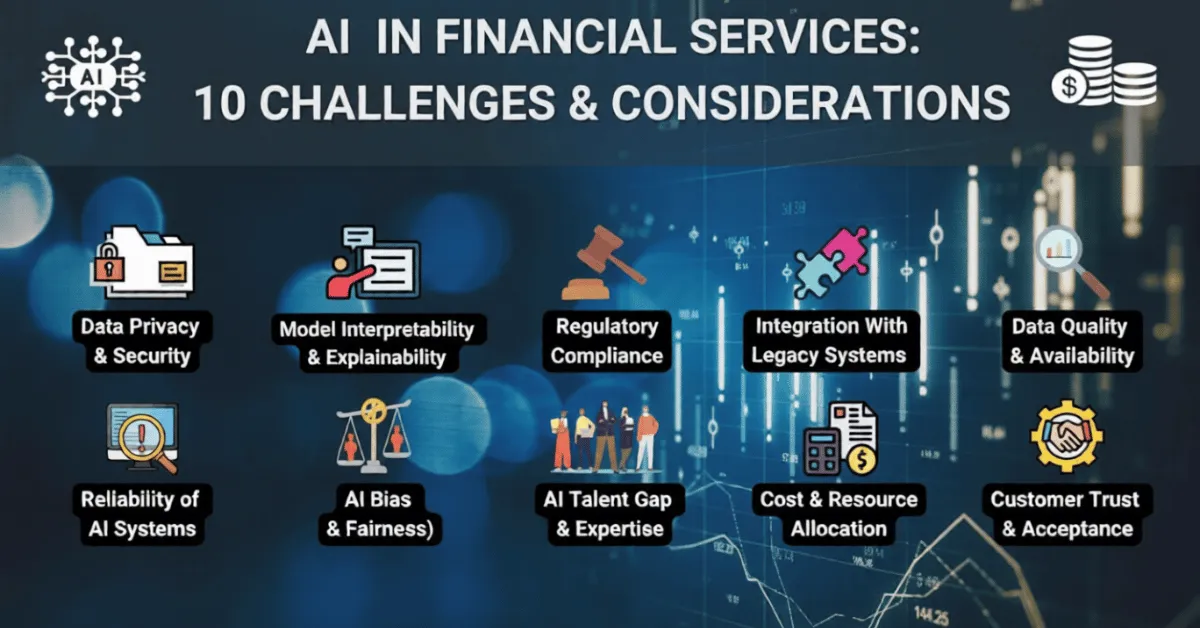
Risks and Challenges of AI in Financial Services
No serious analysis ignores the risks.
Key Challenges
- Data privacy and security
- Algorithmic bias
- Lack of transparency
- Over-reliance on automation
- Regulatory uncertainty
Institutions such as the Bank for International Settlements stress the need for robust AI governance frameworks.
Regulation and Trust in the AI-Driven Financial Future
Trust will determine adoption speed.
Regulators focus on:
- Explainable AI
- Fair lending standards
- Accountability for AI decisions
- Data protection
The future of financial services with AI depends on balancing innovation with stability.
AI, Financial Stability, and Systemic Risk
At scale, AI can amplify both efficiency and risk.
Potential systemic concerns include:
- Herd behavior driven by similar models
- Flash crashes
- Over-optimized strategies
Human oversight remains essential.
Timeline: What the Future Looks Like
- Short term (1–3 years): Automation, fraud detection, personalization
- Medium term (3–7 years): Predictive finance, AI-driven risk systems
- Long term (7–15 years): Autonomous financial infrastructure
The future of financial services with AI is evolutionary, not instant.
What Most Articles Get Wrong
Most content fails because it:
- Focuses only on technology
- Ignores regulation and trust
- Assumes AI replaces humans
- Avoids discussing limits
Real transformation is institutional, not just technical.
Frequently Asked Questions
How will AI change financial services?
AI will make financial services faster, smarter, more personalized, and more efficient.
Will AI replace banks?
No. It will reshape how banks operate and compete.
Is AI in finance risky?
It carries risks, but proper governance significantly reduces them.
Final Conclusion
So, what is the future of financial services with AI?
It is a future where financial decisions become predictive, operations become autonomous, and services become deeply personalized. AI will lower costs, expand access, and redefine competition, while regulation and governance will shape its limits.
Financial services are no longer just about capital.
They are about intelligence, trust, and data.
The institutions that master AI responsibly will define the next era of global finance.