Artificial intelligence is often described as a growth engine for modern economies. While that is largely true, the reality is more complex. Understanding the challenges of AI adoption in the economy requires looking at structural, financial, labor, and institutional barriers that slow or distort its impact.
AI does not enter an economy evenly. It collides with existing systems, incentives, regulations, and skill gaps. This article breaks down the key challenges of AI adoption in the economy, focusing on why adoption is uneven, costly, and difficult despite massive potential.
What Does AI Adoption Mean in Economic Terms?
AI adoption in the economy refers to the integration of artificial intelligence into:
- Production processes
- Labor markets
- Business decision-making
- Public services
- Financial systems
From an economic perspective, adoption is not just about technology. It’s about capital allocation, productivity, labor adjustment, and institutional readiness. That’s where most challenges arise.
Why the Challenges of AI Adoption in the Economy Matter
AI has the potential to:
- Increase productivity
- Raise long-term GDP growth
- Improve efficiency across sectors
But if adoption is uneven or poorly managed, it can:
- Increase inequality
- Disrupt labor markets
- Concentrate economic power
- Slow overall growth
That’s why the challenges of AI adoption in the economy are just as important as the benefits.
1. High Cost of AI Implementation
One of the biggest challenges of AI adoption in the economy is cost.
AI systems require:
- Advanced computing infrastructure
- High-quality data
- Skilled engineers and analysts
- Ongoing maintenance and updates
Large corporations can absorb these costs. Small and medium-sized businesses often cannot, creating an uneven adoption curve.
This capital barrier slows economy-wide productivity gains.
2. Shortage of Skilled Labor
AI adoption depends heavily on human capital.
There is a global shortage of:
- Data scientists
- Machine learning engineers
- AI system managers
- AI-literate decision-makers
This skills gap limits how fast AI can be deployed across industries. According to the Organisation for Economic Co-operation and Development, skill shortages are one of the main bottlenecks preventing AI-driven productivity growth.
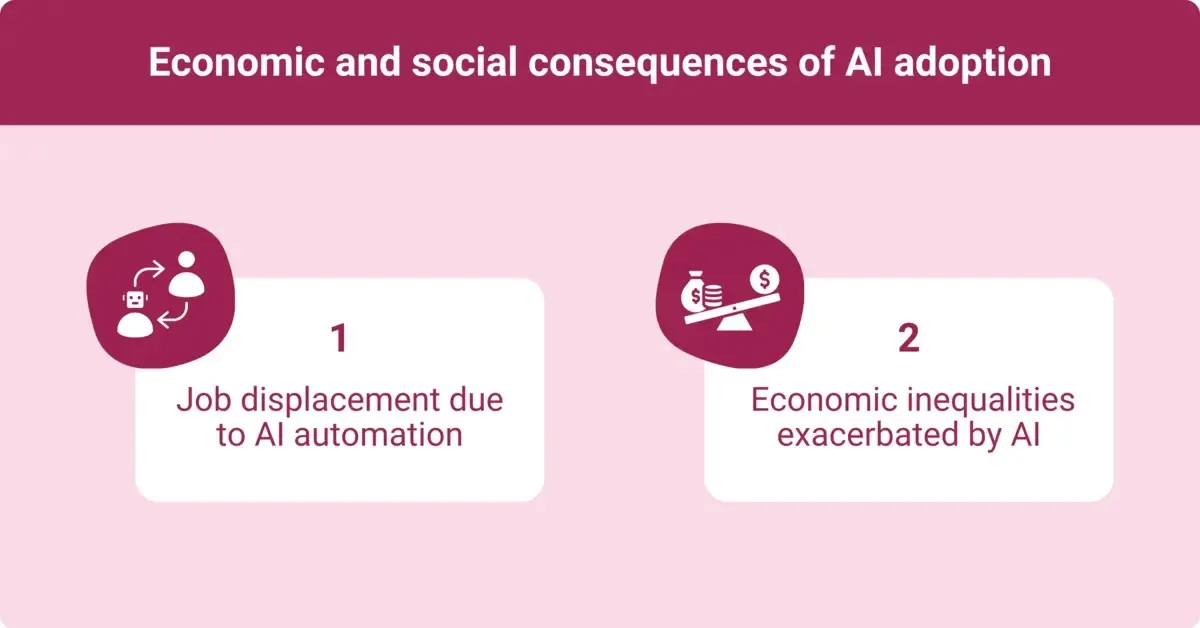
3. Labor Market Disruption and Job Adjustment
Another core challenge of AI adoption in the economy is labor adjustment.
AI:
- Automates routine tasks
- Changes job requirements
- Displaces certain roles faster than workers can retrain
Even when AI creates new jobs, the transition period can be painful. Workers displaced in one sector may not easily move into AI-complementary roles.
This creates friction, unemployment risk, and political resistance.
4. Unequal Distribution of Economic Benefits
AI adoption does not benefit all regions or groups equally.
Economic gains tend to concentrate:
- In large tech firms
- In high-skill workers
- In urban innovation hubs
Rural areas, low-skill workers, and developing regions often lag behind. This inequality is one of the most serious challenges of AI adoption in the economy, as it can increase income and regional disparities.
5. Data Availability and Quality Constraints
AI systems depend on data. Poor data leads to poor outcomes.
Many organizations face:
- Fragmented data systems
- Low-quality or biased datasets
- Limited data access due to privacy laws
Without reliable data, AI adoption stalls or produces unreliable results. This is a hidden but critical economic constraint.
6. Regulatory and Legal Uncertainty
Regulation plays a major role in shaping AI adoption.
Governments struggle with:
- Data privacy laws
- AI accountability standards
- Liability for automated decisions
- Cross-border data flows
Unclear or inconsistent regulation increases uncertainty, discouraging investment. Institutions like the International Monetary Fund have warned that regulatory fragmentation could slow AI-driven economic growth.
7. Ethical and Trust Issues
Public trust affects adoption.
AI raises concerns about:
- Bias and discrimination
- Surveillance and privacy
- Lack of transparency
- Automated decision errors
When trust is low, consumers, workers, and regulators resist AI deployment. This social resistance is an underestimated challenge of AI adoption in the economy.
8. Productivity Paradox of AI
Despite heavy investment, productivity gains from AI have been slower than expected.
This is known as the AI productivity paradox.
Reasons include:
- Poor integration with existing workflows
- Organizational resistance
- Misaligned incentives
- Learning curves
Until firms restructure processes around AI, productivity gains remain limited.
9. Market Concentration and Monopoly Risk
AI adoption favors firms with:
- Large datasets
- Capital resources
- Cloud infrastructure
This can lead to market concentration and reduced competition. When a few firms dominate AI capabilities, innovation slows and economic power becomes centralized.
This structural imbalance is a serious long-term challenge.
10. Infrastructure and Energy Constraints
AI systems are resource-intensive.
They require:
- Massive computing power
- Reliable electricity
- Data centers and networks
As AI adoption scales, energy demand rises, creating cost and sustainability challenges. Infrastructure limitations can slow adoption at the national level.
11. AI Adoption in the Public Sector
Governments face unique challenges.
Public institutions often struggle with:
- Legacy IT systems
- Procurement rules
- Skill shortages
- Risk aversion
Yet public-sector AI adoption is critical for healthcare, education, taxation, and regulation efficiency.
12. Global Inequality in AI Adoption
At the international level, AI adoption is uneven.
Developed economies lead, while developing countries face:
- Capital constraints
- Skill shortages
- Infrastructure gaps
Organizations like the World Bank highlight the risk that AI could widen global economic inequality if adoption remains uneven.
How These Challenges Slow Economic Growth
Combined, these challenges:
- Delay productivity gains
- Reduce labor market flexibility
- Increase adjustment costs
- Create political and social resistance
AI’s economic benefits depend not just on technology, but on institutions, education, and policy alignment.
What Economies Need to Overcome AI Adoption Challenges
To address the challenges of AI adoption in the economy, countries need:
- Large-scale reskilling programs
- Support for small businesses
- Clear and flexible regulation
- Investment in digital infrastructure
- Ethical AI governance frameworks
Without these, AI adoption remains fragmented.
Long-Term Outlook: Can the Economy Adapt?
History shows that economies eventually adapt to major technologies. But the speed and quality of adaptation matter.
AI will likely:
- Reshape job structures
- Increase productivity over time
- Reward adaptable economies
Those that fail to address the challenges of AI adoption in the economy risk falling behind.
Frequently Asked Questions
What is the biggest challenge of AI adoption in the economy?
The skills gap and uneven distribution of benefits are among the biggest challenges.
Does AI adoption always increase productivity?
Not immediately. Productivity gains depend on proper integration and organizational change.
Can regulation slow AI adoption?
Yes. Poorly designed or inconsistent regulation can discourage investment.
Final Conclusion
So, what are the challenges of AI adoption in the economy?
They include high costs, skill shortages, labor disruption, inequality, data limitations, regulatory uncertainty, and infrastructure constraints. AI is powerful, but it is not plug-and-play at the economic level.
The real challenge is not whether AI works. It’s whether economies are prepared to adapt their institutions, workforce, and policies fast enough to benefit from it.AI will reshape the economy. The question is who manages the transition well and who doesn’t.