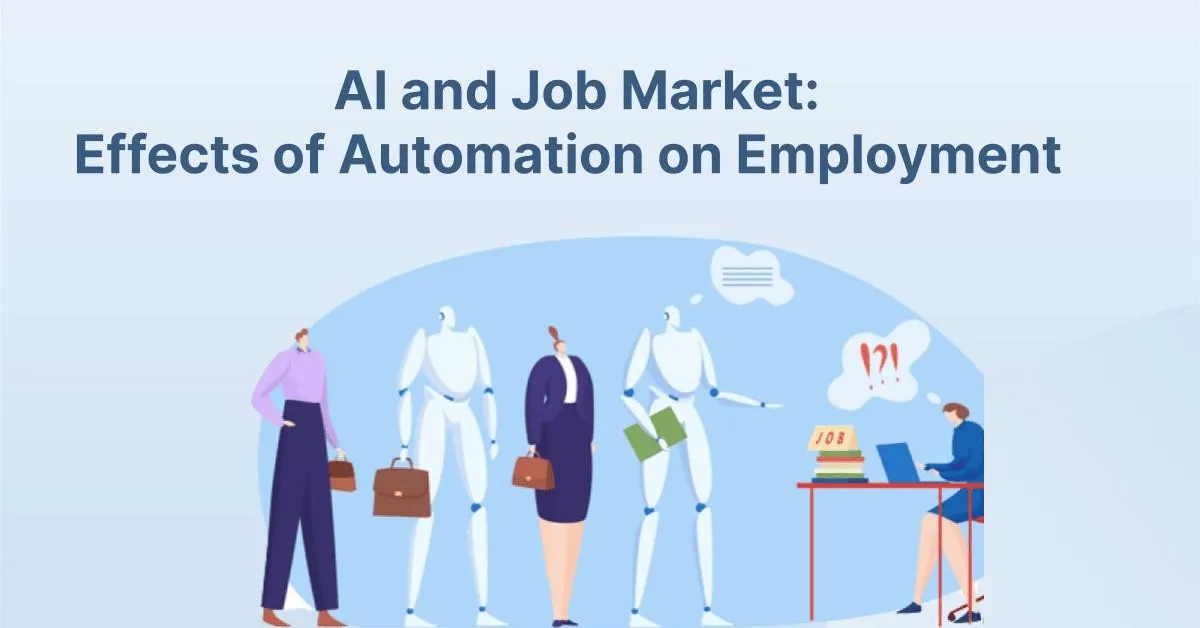
Artificial intelligence is changing how work is done, not just what work exists. Understanding how AI affects jobs and employment requires moving past fear-driven narratives and looking at real labor market data, productivity effects, and skill transformation.
AI is automating tasks, augmenting human capabilities, and reshaping industries at the same time. The result is not a simple story of job loss, but a complex reorganization of employment across the economy.
This article explains how AI affects jobs and employment, using economic logic, sector-level examples, and long-term workforce trends.
What Does AI Mean for Jobs and Employment?
In labor economics, AI refers to technologies that can perform cognitive or physical tasks traditionally done by humans. These include machine learning systems, automation software, robotics, and data-driven decision tools.
AI affects employment by:
- Automating routine tasks
- Increasing worker productivity
- Changing skill requirements
- Creating new job categories
- Shifting labor demand across sectors
This interaction defines how AI affects jobs and employment at scale.
How AI Affects Jobs and Employment Today
AI’s impact on jobs is already visible across multiple industries.
1. AI Automates Tasks, Not Entire Jobs
One of the most misunderstood aspects of how AI affects jobs and employment is automation.
AI usually replaces tasks, not full occupations.
For example:
- Accountants use AI for data entry, not judgment
- Doctors use AI for diagnostics, not patient care
- Lawyers use AI for document review, not legal strategy
This task-level automation increases efficiency while preserving human roles.
2. AI Is Changing Job Skill Requirements
AI increases demand for certain skills while reducing demand for others.
Skills in Growing Demand
- Data analysis
- Critical thinking
- Technical literacy
- Creativity and problem-solving
- AI system oversight
Routine and repetitive skills are declining in value. This shift is central to how AI affects jobs and employment in the modern economy.
3. AI Creates New Jobs and Occupations
AI does not only displace work. It creates entirely new roles.
Examples include:
- AI trainers and auditors
- Data scientists
- Machine learning engineers
- AI ethics specialists
- Automation managers
According to the World Economic Forum, technology-driven job creation offsets a significant share of displacement over time.
4. AI Is Increasing Productivity Per Worker
Higher productivity changes employment dynamics.
AI enables workers to:
- Produce more output per hour
- Focus on higher-value tasks
- Reduce error rates
Productivity gains support economic growth, which in turn sustains long-term employment levels.
This productivity channel is often ignored when discussing how AI affects jobs and employment.
5. AI Is Reshaping Wages and Income Distribution
AI affects wages unevenly.
Wage Effects
- High-skill workers see wage growth
- Middle-skill routine jobs face pressure
- Low-skill service jobs remain resilient
This leads to wage polarization, not universal job loss.
Data from the Bureau of Labor Statistics shows that job growth remains strong in roles that combine technical and human skills.
6. Sector-by-Sector Impact of AI on Employment
To fully understand how AI affects jobs and employment, you must examine specific sectors.
AI in Manufacturing Jobs
AI-powered automation:
- Reduces manual assembly tasks
- Increases demand for technicians and engineers
- Improves quality control
Manufacturing jobs are evolving, not disappearing.
AI in Office and Administrative Jobs
AI automates:
- Scheduling
- Data entry
- Reporting
But increases demand for:
- Analysts
- Managers
- Decision-makers
AI in Healthcare Employment
AI supports:
- Diagnostics
- Medical imaging
- Administrative efficiency
Healthcare employment continues to grow due to aging populations and service demand.
AI in Finance and Professional Services
AI affects:
- Accounting
- Auditing
- Legal research
- Risk analysis
Professionals who use AI become more productive and valuable.
7. AI and Employment in Small Businesses
Small businesses use AI to:
- Automate marketing
- Improve customer service
- Manage finances
This allows small teams to scale, increasing entrepreneurship and job creation.
8. AI Is Changing How Hiring Works
AI affects employment not just through automation, but through hiring itself.
AI is used in:
- Resume screening
- Skill matching
- Workforce analytics
This changes how workers enter the labor market.
9. Long-Term Employment Effects of AI
Economists generally agree on three long-term trends:
- Job roles will change faster
- Lifelong learning will become essential
- Human-AI collaboration will define most jobs
Institutions like the Organisation for Economic Co-operation and Development emphasize that reskilling is key to positive employment outcomes.
10. Risks and Challenges of AI for Employment
Understanding how AI affects jobs and employment also means acknowledging risks.
Key Challenges
- Short-term job displacement
- Skills mismatches
- Unequal access to retraining
- Regional employment disruption
These are policy and education challenges, not failures of AI itself.
Role of Education and Reskilling
The impact of AI on jobs depends heavily on workforce readiness.
Effective responses include:
- Technical education
- Vocational retraining
- Employer-led upskilling
- Public-private training partnerships
Countries that invest in skills benefit more from AI adoption.
AI Will Not Replace Humans, But Humans Using AI Will Replace Those Who Don’t
This principle captures the real story of how AI affects jobs and employment.
Workers who:
- Learn AI tools
- Adapt to new workflows
- Combine human judgment with AI output
remain in high demand.
Frequently Asked Questions
Will AI cause mass unemployment?
Most evidence suggests job transformation, not mass unemployment.
Which jobs are most affected by AI?
Routine and repetitive tasks are most exposed.
Can AI create more jobs than it destroys?
Historically, technology has done so, especially with proper policy support.
Final Conclusion
So, how AI affects jobs and employment?
AI automates tasks, raises productivity, reshapes skills, creates new roles, and changes how work is organized. While disruption is real, long-term employment depends on adaptation, education, and smart policy.
AI is not the end of work. It is the next evolution of it.