
Blockchain scalability has been one of the biggest obstacles to mass adoption. Slow transaction speeds, high gas fees, and network congestion prevent blockchains from supporting global-scale applications. This is where artificial intelligence becomes a powerful enabler. Understanding how AI improves blockchain scalability requires looking beyond simple throughput metrics and into how AI optimizes networks, data flow, and decision-making.
AI does not replace blockchain architecture. It enhances it. By adding intelligence to transaction processing, network coordination, and resource allocation, AI helps blockchains scale efficiently without sacrificing decentralization or security.
This article explains how AI improves blockchain scalability, covering real mechanisms, infrastructure layers, and future-ready solutions most competitors fail to explain.
Why Blockchain Scalability Is a Problem
Blockchain scalability refers to a network’s ability to handle increasing transaction volume without performance degradation.
Major scalability challenges include:
- Limited transactions per second (TPS)
- Network congestion
- High gas fees
- Latency in block confirmation
- Inefficient node coordination
- Resource-heavy consensus mechanisms
Even advanced blockchains like Ethereum continue to face scalability constraints during peak demand.
What Does Blockchain Scalability Mean in Practice?
Scalability is not just speed. It includes:
- Throughput (TPS)
- Latency (confirmation time)
- Cost efficiency (fees)
- Network stability under load
- Ability to scale nodes and users simultaneously
This is where AI plays a crucial role.
How AI Improves Blockchain Scalability: Core Mechanisms
Let’s break down exactly how AI improves blockchain scalability at different layers of blockchain infrastructure.
1. AI-Based Transaction Optimization
AI optimizes how transactions are processed and prioritized.
AI systems:
- Predict transaction demand
- Optimize transaction ordering
- Reduce congestion during peak periods
- Improve mempool management
By dynamically managing transaction flow, AI increases effective throughput without changing block size.
2. AI for Smart Load Balancing Across Nodes
Node coordination is a hidden scalability bottleneck.
AI improves blockchain scalability by:
- Distributing workload across nodes intelligently
- Preventing node overload
- Optimizing data propagation paths
This reduces latency and improves overall network performance.
3. AI-Driven Consensus Optimization
Consensus mechanisms are resource-intensive.
AI enhances scalability by:
- Predicting validator behavior
- Reducing redundant communication
- Optimizing leader selection
- Detecting inefficient consensus cycles
AI-assisted consensus improves speed without compromising decentralization.
4. AI and Layer 2 Scaling Solutions
Layer 2 solutions are essential for blockchain scalability.
AI improves Layer 2 systems by:
- Optimizing rollup batching
- Predicting settlement timing
- Managing off-chain transaction aggregation
- Reducing on-chain settlement load
This dramatically lowers fees and increases throughput.
5. AI for Sharding Optimization
Sharding divides the blockchain into smaller partitions.
AI improves sharding by:
- Dynamically assigning shards
- Balancing shard load
- Predicting cross-shard communication needs
Without AI, static sharding leads to bottlenecks and uneven performance.
6. AI in Network Traffic Prediction
Network congestion often comes from unpredictable demand.
AI models:
- Forecast transaction spikes
- Anticipate congestion events
- Pre-allocate resources
This predictive capability is a major reason how AI improves blockchain scalability beyond reactive solutions.
7. AI-Based Gas Fee Optimization
High gas fees reduce usability.
AI improves fee markets by:
- Predicting optimal fee levels
- Reducing bidding wars
- Smoothing price volatility
This makes blockchain usage more affordable at scale.
8. AI for State Management and Data Compression
Blockchain state size grows continuously.
AI improves scalability by:
- Optimizing state storage
- Compressing historical data
- Identifying redundant information
Smaller state sizes improve node performance and decentralization.
9. AI and Cross-Chain Scalability
Multi-chain ecosystems increase scalability but add complexity.
AI improves cross-chain scalability by:
- Optimizing bridge throughput
- Predicting liquidity movement
- Reducing cross-chain congestion
As ecosystems grow, this becomes increasingly important.
10. AI-Driven Resource Allocation
Blockchain infrastructure consumes compute, storage, and bandwidth.
AI dynamically allocates:
- Compute power
- Network bandwidth
- Validator resources
This ensures resources scale efficiently with demand.
How AI Improves Blockchain Scalability Compared to Traditional Methods
Traditional Scaling Approaches
- Fixed block sizes
- Static sharding
- Manual parameter tuning
AI-Enhanced Scaling
- Adaptive optimization
- Predictive scaling
- Continuous learning
This adaptability is the core advantage of AI-driven scalability.
Real-World Use of AI for Blockchain Scalability
Enterprise and public blockchains increasingly integrate AI.
Companies like IBM use AI-enhanced blockchain infrastructure to support high-throughput enterprise use cases such as supply chains and financial systems.
Public blockchains also rely on AI-powered analytics to monitor and optimize network performance.
Benefits of AI-Enhanced Blockchain Scalability
Key benefits include:
- Higher transaction throughput
- Lower fees
- Reduced latency
- Better user experience
- Improved network stability
These benefits accelerate mainstream adoption.
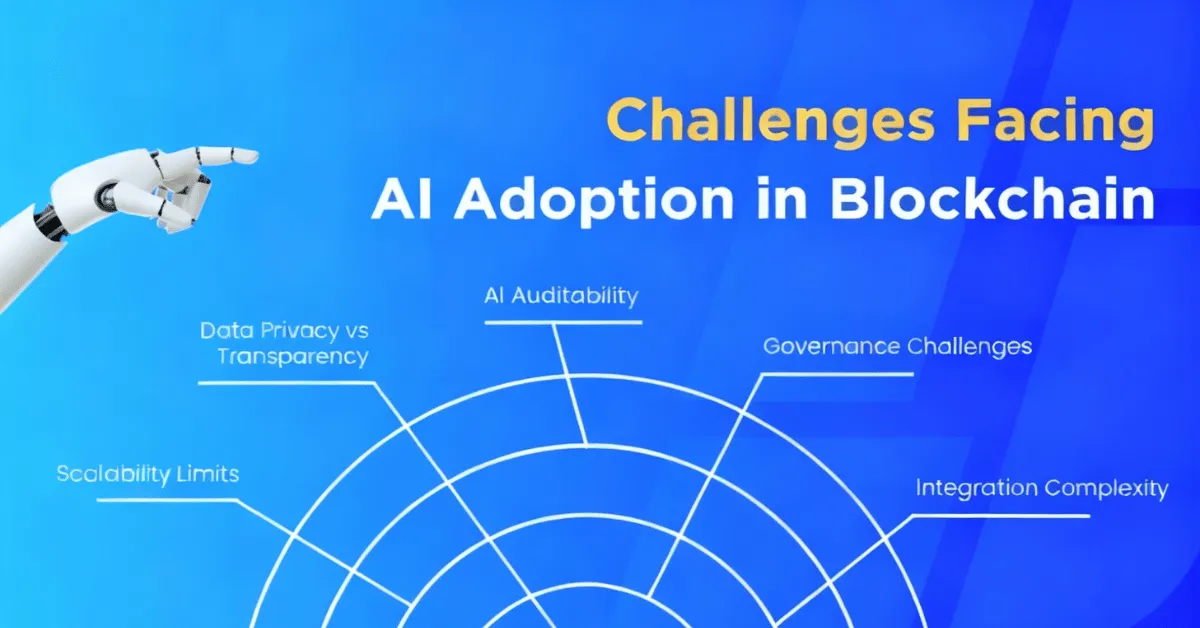
Limitations of AI in Blockchain Scalability
Understanding how AI improves blockchain scalability also requires acknowledging limitations.
Key Limitations
- Increased system complexity
- AI model training costs
- Risk of centralization if poorly designed
- Dependence on quality data
AI must be implemented carefully to preserve decentralization.
AI, Scalability, and Decentralization Trade-Offs
Poorly implemented AI can centralize control.
Best practices include:
- Open-source AI models
- Transparent governance
- Distributed AI agents
Scalability should not come at the cost of trust.
The Future of AI and Blockchain Scalability
Looking ahead, AI will:
- Power self-optimizing blockchains
- Enable autonomous scaling
- Support global-scale decentralized applications
Blockchains that integrate AI natively will scale faster and more sustainably.
Frequently Asked Questions
How does AI improve blockchain scalability?
By optimizing transaction flow, consensus, resource allocation, and network performance.
Can AI replace layer 2 solutions?
No. AI enhances layer 2 efficiency but does not replace them.
Does AI reduce gas fees?
Yes. AI helps optimize fee markets and reduce congestion-driven costs.
Final Conclusion
So, how AI improves blockchain scalability?
AI adds intelligence, prediction, and adaptability to blockchain systems. It optimizes transaction processing, reduces congestion, improves consensus efficiency, and enables networks to scale dynamically with demand.
Blockchain provides trust and decentralization.
AI provides efficiency and intelligence.
Together, they make scalable blockchain systems possible.