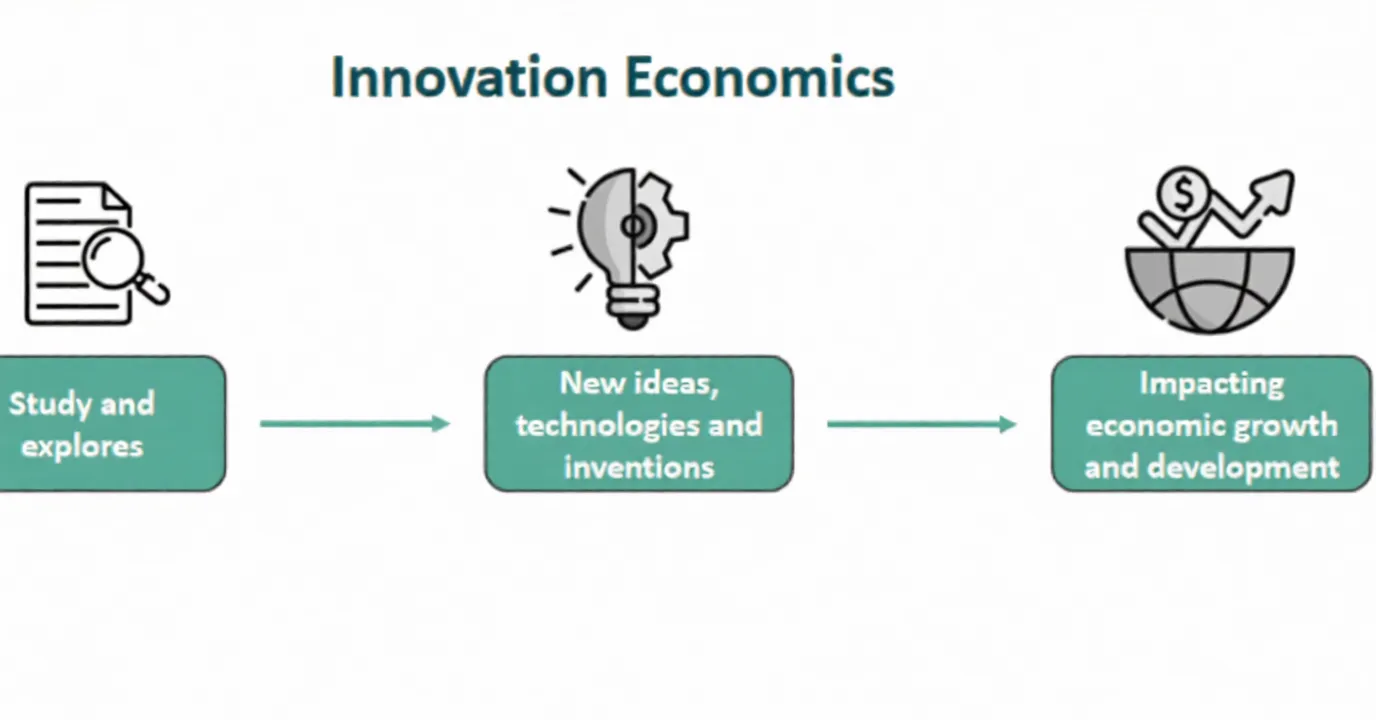
Innovation is not just about new ideas or technologies. It is the primary force that determines how economies grow, compete, and adapt over time. Understanding how innovation shapes modern economies requires looking beyond startups and inventions and into productivity, labor markets, global trade, and institutional change.
From industrial revolutions to digital platforms and artificial intelligence, innovation has consistently reshaped economic structures, altered power dynamics, and redefined living standards. This article explains how innovation shapes modern economies by breaking down the actual economic mechanisms most discussions overlook.
What Is Innovation in an Economic Context?
In economics, innovation refers to the development and adoption of:
- New products and services
- New production processes
- New business models
- New organizational and institutional systems
Innovation is not valuable simply because it is new. It matters because it changes how resources are used, increasing efficiency, output, or quality.
This distinction is essential to understanding how innovation shapes modern economies.
Why Innovation Is Central to Modern Economic Growth
Traditional growth relied on:
- More labor
- More capital
- More natural resources
Modern economies grow primarily through productivity gains, and innovation is the main source of productivity.
Innovation allows economies to:
- Produce more with the same inputs
- Reduce costs
- Improve quality and variety
- Create entirely new markets
This is why advanced economies prioritize innovation over resource expansion.
How Innovation Shapes Modern Economies: Core Mechanisms
Let’s break down the real channels through which innovation reshapes economies.
1. Innovation Drives Productivity Growth
Productivity is the single most important determinant of long-term economic growth.
Innovation improves productivity by:
- Automating tasks
- Optimizing production processes
- Reducing waste and inefficiency
- Improving coordination across markets
Higher productivity leads to higher wages, higher profits, and higher national income.
This productivity channel is the foundation of how innovation shapes modern economies.
2. Innovation Transforms Labor Markets
Innovation reshapes not just what is produced, but how people work.
Key labor market effects include:
- Creation of new occupations
- Decline of routine and repetitive jobs
- Increased demand for skills and adaptability
- Changes in wage structures
While innovation can displace certain jobs, it also creates new forms of employment that did not previously exist.
3. Innovation Creates New Industries and Markets
Entire industries exist today because of innovation.
Examples include:
- Information technology
- Biotechnology
- Fintech
- Renewable energy
- Digital services
These industries contribute significantly to GDP, exports, and employment. Their emergence illustrates clearly how innovation shapes modern economies at a structural level.
4. Innovation Enhances Global Competitiveness
In a globalized world, countries compete on innovation capacity.
Innovative economies:
- Export high-value goods and services
- Attract investment and talent
- Maintain technological leadership
- Influence global standards
Countries that fail to innovate risk stagnation, even if they are resource-rich.
5. Innovation Changes Business Models and Firm Dynamics
Modern innovation is not limited to technology. It also reshapes how firms operate.
Innovation enables:
- Platform-based businesses
- Subscription models
- Data-driven decision-making
- Scalable digital enterprises
This leads to:
- Faster firm growth
- Winner-takes-most dynamics
- Increased market concentration
These firm-level effects play a major role in how innovation shapes modern economies today.
6. Innovation Improves Living Standards and Consumer Welfare
Economic growth is not just about output. It is about well-being.
Innovation improves living standards by:
- Lowering prices
- Increasing product quality
- Expanding consumer choice
- Improving healthcare, communication, and mobility
Many modern conveniences are the result of decades of cumulative innovation.
7. Innovation Accelerates Structural Economic Change
Modern economies continuously shift resources across sectors.
Innovation drives:
- Movement from agriculture to manufacturing
- Shift from manufacturing to services
- Growth of knowledge-based industries
These structural changes determine long-term economic trajectories.
8. Innovation and Entrepreneurship in Modern Economies
Entrepreneurship is a key channel through which innovation enters the economy.
Innovative entrepreneurs:
- Commercialize new ideas
- Disrupt existing industries
- Introduce competition
- Create jobs
Startup ecosystems play a critical role in innovation diffusion across modern economies.
9. Innovation Diffusion: The Most Overlooked Factor
Innovation does not shape economies simply by existing. It must be adopted.
Diffusion determines:
- How fast innovation spreads
- Who benefits first
- Whether productivity gains are widespread
Many economies fail not because they lack innovation, but because adoption is slow or uneven.
This diffusion gap is often ignored when discussing how innovation shapes modern economies.
10. Innovation, Inequality, and Distributional Effects
Innovation does not benefit everyone equally.
Common distributional effects include:
- Higher returns to skills and capital
- Wage polarization
- Regional economic divergence
Institutions such as the Organisation for Economic Co-operation and Development highlight that innovation-driven growth must be paired with education and redistribution policies to remain inclusive.
Role of Institutions and Policy in Shaping Innovation Outcomes
Innovation does not occur in a vacuum.
Key institutional factors include:
- Education systems
- Research funding
- Intellectual property rights
- Financial markets
- Regulatory frameworks
Public policy shapes whether innovation leads to broad-based growth or concentrated gains.
Innovation and the Digital Economy
The digital economy has amplified innovation’s impact.
Digital innovation enables:
- Faster scaling
- Global reach
- Lower entry barriers
- Network effects
This accelerates both growth and disruption, intensifying how innovation shapes modern economies in the 21st century.
Innovation in Developing vs Advanced Economies
Innovation plays different roles depending on development level.
- Advanced economies focus on frontier innovation
- Developing economies focus on adoption and adaptation
Both paths are valid, but policy priorities differ.
Organizations like the World Bank emphasize innovation diffusion as a key driver of development.
Risks and Limits of Innovation-Led Growth
No serious analysis ignores constraints.
Key Risks
- Technological unemployment in the short term
- Market concentration
- Regulatory lag
- Environmental impact
Innovation must be guided, not assumed to self-correct.
The Long-Term Economic Impact of Innovation
Over the long term, innovation:
- Raises potential GDP
- Improves resilience to shocks
- Enables adaptation to demographic and climate challenges
Economies that innovate continuously are better equipped to face uncertainty.
What Most Articles Get Wrong
Most discussions fail because they:
- Treat innovation as automatic progress
- Ignore adoption and institutions
- Overlook inequality effects
- Focus only on technology
Real economic impact depends on systems, not slogans.
Frequently Asked Questions
Why is innovation important for modern economies?
Because it drives productivity, growth, competitiveness, and living standards.
Does innovation always create jobs?
Not immediately, but historically it creates new forms of employment over time.
Can economies grow without innovation?
Only temporarily. Long-term growth requires innovation.
Final Conclusion
So, how innovation shapes modern economies?
Innovation is the engine behind productivity growth, structural change, global competitiveness, and rising living standards. It reshapes labor markets, transforms industries, and determines which economies lead and which fall behind.
But innovation alone is not enough. Adoption, institutions, and policy determine whether its benefits are broad or concentrated.Modern economies are not defined by what they produce.
They are defined by how fast they innovate and how well they adapt.